
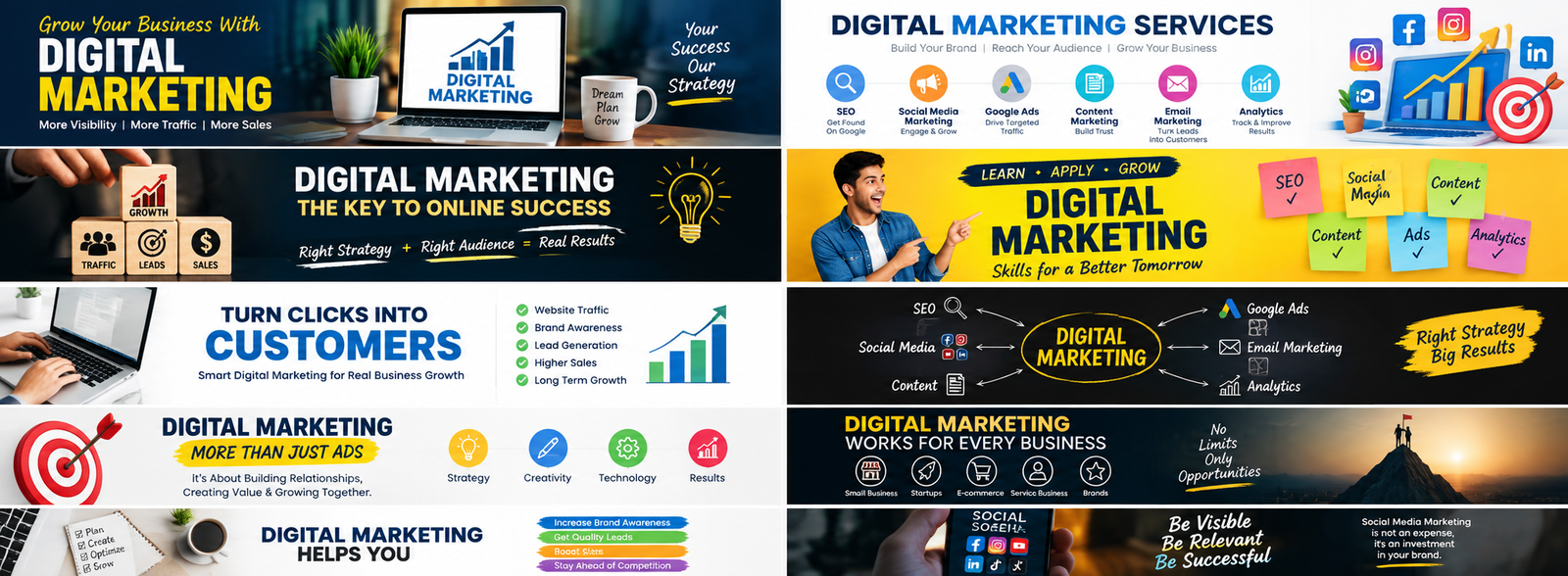
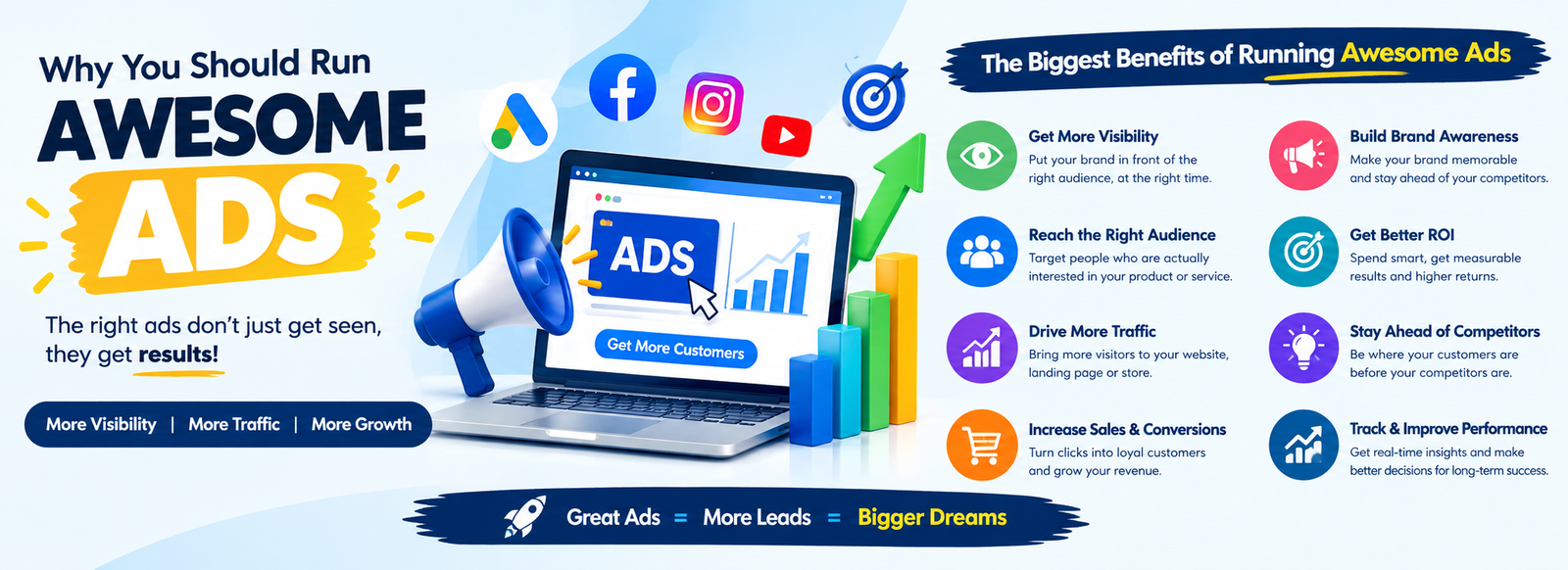
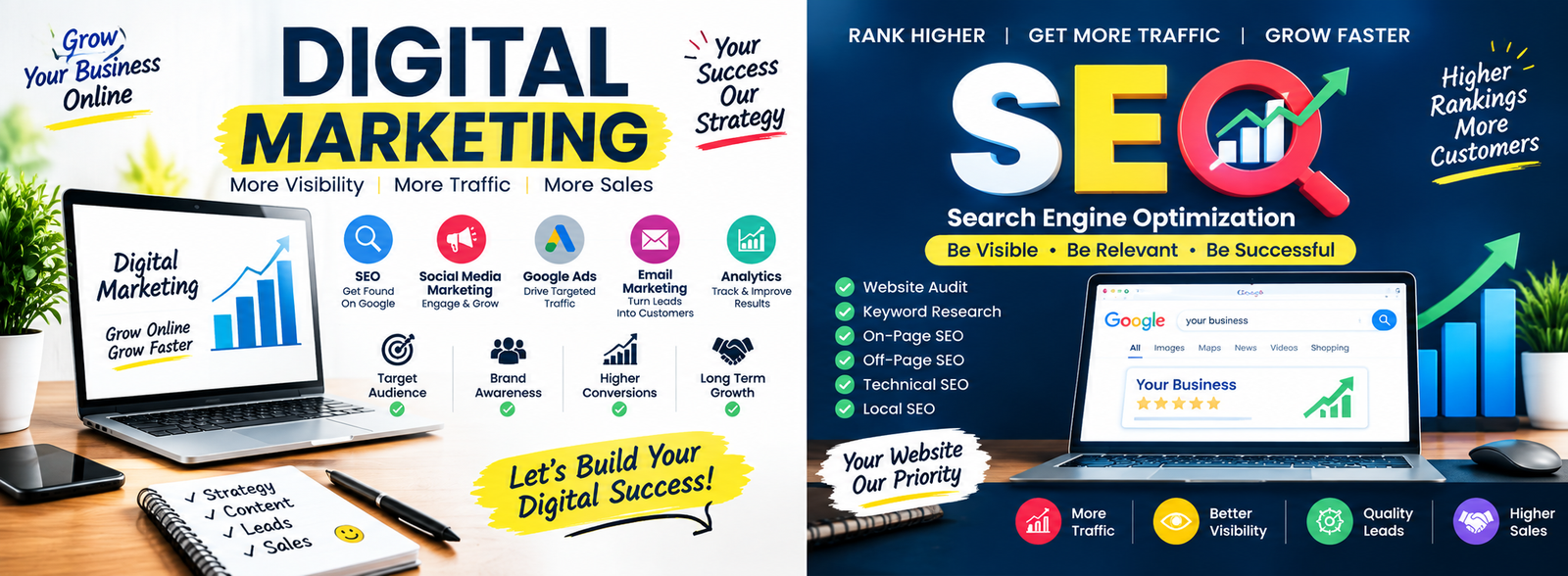
Why Choose Digital Marketing?
- Reach More Customers – Apne business ko local se global audience tak pahunchayein.
- Increase Brand Awareness – Online presence ke through apne brand ko strong banayein.
- Generate Quality Leads – Potential customers ko attract karke business leads increase karein.
- Boost Sales & Revenue – Effective digital strategies se sales aur business growth badhayein.
- Cost-Effective Marketing – Traditional marketing ke comparison mein budget-friendly campaigns run karein.
- Target the Right Audience – Age, location, interests aur online behavior ke basis par customers ko target karein.
- Build Customer Trust – Professional online presence aur valuable content se credibility improve karein.
- Measurable Results – Campaign performance, traffic, leads aur conversions ko easily track karein.
- Stay Ahead of Competitors – Strong digital presence ke saath competition mein active rahein.
- 24/7 Online Presence – Aapka business customers ke liye online available rahe, anytime and anywhere.
- Improve Customer Engagement – Social media, content aur online communication ke through customers se connected rahein.
- Long-Term Business Growth – Consistent digital marketing se sustainable growth aur stronger brand identity build karein.
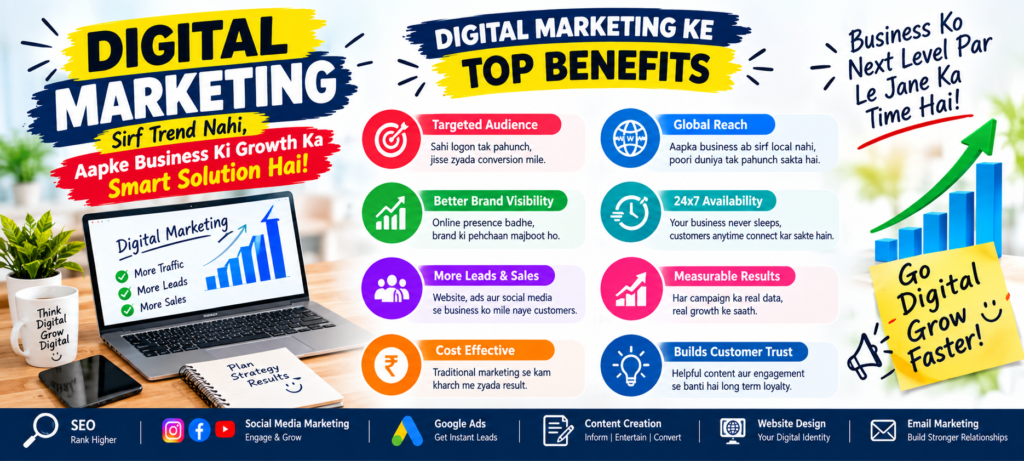
Top Benefits of Digital Marketing
Digital marketing has become one of the most important ways for businesses to reach customers, build their brand, generate leads, and increase sales. In today’s digital world, customers spend a significant amount of time online searching for products, services, information, reviews, and solutions. Because of this, businesses need a strong online presence to connect with their target audience.
Digital marketing includes different online strategies such as Search Engine Optimization (SEO), Google Ads, Social Media Marketing, Content Marketing, Email Marketing, Website Development, Online Reputation Management, and Lead Generation. When these strategies are planned and implemented correctly, they can help businesses achieve measurable and sustainable growth.
Here are the top benefits of digital marketing for businesses of all sizes.
1. Reach a Larger Audience
One of the biggest benefits of digital marketing is the ability to reach a large audience beyond your local area. Traditional marketing methods are often limited by location, while digital marketing allows businesses to connect with customers across cities, states, countries, and even worldwide markets.
A well-optimized website, social media campaign, search engine campaign, or online advertisement can introduce your business to thousands of potential customers.
Whether you are a small local business or a growing company, digital marketing gives you the opportunity to expand your reach and connect with people who are genuinely interested in your products or services.
2. Increase Brand Awareness
Building a recognizable brand is important for long-term business growth. Digital marketing helps businesses create and maintain a strong online identity.
Through SEO, social media, content, videos, advertisements, and consistent branding, customers can become more familiar with your business.
When people repeatedly see your brand online and find useful information from your business, they are more likely to remember your company when they need a product or service.
Strong digital visibility can help turn an unknown business into a recognizable brand.
3. Generate Quality Leads
Digital marketing can help businesses attract potential customers who are actively searching for their products or services.
For example, SEO can help your website appear when people search for relevant keywords. Google Ads can place your business in front of people with specific search intent. Social media campaigns can attract users based on their interests and behavior.
These methods can help generate leads from people who are more likely to be interested in what your business offers.
Instead of reaching everyone, digital marketing allows businesses to focus on relevant audiences.
4. Increase Sales and Revenue
The ultimate goal of many marketing activities is business growth. Digital marketing can support this goal by bringing more visitors, leads, inquiries, and potential customers to your business.
A combination of SEO, paid advertising, social media, content marketing, and conversion-focused website strategies can create multiple opportunities for customers to discover and purchase from your business.
With the right strategy, digital marketing can become an important part of your overall sales process.
5. Cost-Effective Marketing
Digital marketing can be more flexible and cost-effective than many traditional marketing methods.
Businesses can decide how much they want to spend on advertising and can adjust their budgets according to campaign performance.
For example, a business can start with a smaller advertising budget, analyze the results, and gradually increase investment in campaigns that are delivering useful results.
This flexibility makes digital marketing suitable for startups, small businesses, medium-sized companies, and large organizations.
6. Target the Right Audience
One of the major advantages of digital marketing is audience targeting.
Businesses can target customers based on factors such as:
Location
Age group
Interests
Search behavior
Online activity
Demographics
Device usage
Customer interests
Previous interactions
This allows businesses to show relevant messages to specific groups of people instead of marketing to a completely broad audience.
Better targeting can help businesses use their marketing budget more efficiently.
7. Improve Search Engine Visibility
Customers often use search engines to find products, services, companies, and information. Search Engine Optimization helps businesses improve their visibility in search results.
A properly optimized website can attract organic traffic from people searching for relevant keywords.
SEO can help improve:
Website visibility
Organic traffic
Brand exposure
Search rankings
Online credibility
Potential customer discovery
SEO is generally a long-term strategy that requires consistent effort, quality content, technical optimization, and a good user experience.
8. Build a Strong Online Presence
Having a website alone is not always enough. Businesses need a complete online presence across relevant digital platforms.
Digital marketing can help businesses build visibility through:
Websites
Search engines
Social media
Business listings
Online directories
Blogs
Videos
Email communication
Digital advertising
A strong online presence makes it easier for potential customers to discover and learn about your business.
9. Connect with Customers 24/7
The internet operates around the clock, allowing customers to discover your business at any time.
Your website can provide information about your products, services, contact details, FAQs, and business offerings even when your physical office is closed.
Similarly, social media profiles and online content can continue attracting visitors and generating awareness beyond traditional business hours.
This creates opportunities for customers to interact with your business whenever it is convenient for them.
10. Improve Customer Engagement
Digital marketing provides many ways to communicate directly with customers.
Businesses can engage with customers through:
Social media comments
Messages
Emails
Online reviews
Blog content
Videos
Surveys
Website forms
Online communities
Regular engagement can help businesses understand customer needs, answer questions, share useful information, and maintain relationships with their audience.
11. Measure Marketing Performance
Another major benefit of digital marketing is the ability to track performance.
Businesses can monitor different metrics such as:
Website visitors
Traffic sources
Leads
Clicks
Impressions
Engagement
Conversion rates
Advertising performance
Search visibility
Customer interactions
These insights help businesses understand what is working and where improvements may be required.
Instead of relying only on assumptions, businesses can use data to make informed marketing decisions.
12. Make Data-Driven Decisions
Digital marketing provides valuable information about customer behavior.
Businesses can learn which pages customers visit, which advertisements receive attention, which content generates engagement, and which marketing channels produce leads.
This information can be used to improve future campaigns.
Data-driven marketing helps businesses continuously test, analyze, and improve their strategies.
13. Improve Customer Trust and Credibility
Customers often research a company online before making a purchase decision.
A professional website, active social media presence, useful content, positive reviews, and consistent branding can help create a professional image.
Digital marketing allows businesses to demonstrate their expertise by sharing valuable information and answering customer questions.
A strong online presence can contribute to customer confidence and brand credibility.
14. Stay Competitive
Almost every industry has businesses competing for customers online.
If your competitors are actively using SEO, social media, online advertising, and content marketing while your business has limited online visibility, potential customers may discover your competitors first.
Digital marketing helps businesses remain visible and participate actively in the online marketplace.
It also provides opportunities to identify competitors, understand market trends, and develop strategies for reaching customers.
15. Support Local Business Growth
Digital marketing is not only useful for global companies. Local businesses can also benefit significantly.
Local SEO, Google Business Profile optimization, location-based advertising, social media marketing, and local content can help businesses reach customers in specific areas.
For example, restaurants, clinics, educational institutes, service providers, retailers, real estate companies, and local professionals can use digital marketing to attract customers from their surrounding locations.
16. Expand into New Markets
Digital marketing makes it easier for businesses to explore new markets.
A company can use online advertising, SEO, social media, and content marketing to test demand in different locations before making major investments.
Businesses can identify new audiences, understand their interests, and develop campaigns specifically for those markets.
This can create opportunities for business expansion.
17. Generate Long-Term Organic Traffic
SEO and content marketing can help businesses attract organic traffic over time.
High-quality content such as blogs, guides, FAQs, service pages, and educational resources can continue attracting visitors after publication.
Unlike a short-term advertisement that stops generating traffic when the campaign ends, useful organic content can continue providing value for an extended period.
This makes content and SEO important components of a long-term digital marketing strategy.
18. Improve Website Traffic
Digital marketing can increase the number of people visiting your website.
Different channels can contribute to website traffic, including:
Google Search
Social Media
Paid Advertising
Email Marketing
Referral Traffic
Online Directories
Content Marketing
More relevant traffic can create more opportunities for inquiries, leads, subscriptions, and sales.
However, traffic quality is also important. The goal should not simply be to increase visitor numbers but to attract people who are relevant to the business.
19. Increase Customer Retention
Digital marketing can help businesses stay connected with existing customers.
Email campaigns, social media updates, useful content, special announcements, customer support, and personalized communication can help maintain relationships with existing customers.
Keeping customers engaged can encourage repeat interactions and support long-term customer relationships.
20. Personalize Customer Communication
Digital platforms allow businesses to create more relevant communication for different customer groups.
For example, businesses can create different campaigns for new customers, existing customers, returning visitors, or people who previously interacted with specific products or services.
Relevant communication can create a better customer experience and help businesses deliver information that matches customer interests.
21. Build a Strong Social Media Presence
Social media has become an important communication channel for many businesses.
Platforms such as Facebook, Instagram, LinkedIn, YouTube, and other social networks provide opportunities to share:
Products
Services
Company updates
Educational content
Customer stories
Videos
Offers
Industry information
A consistent social media strategy can increase brand visibility and provide another way for customers to communicate with the business.
22. Improve Content Marketing
Content is an important part of digital marketing.
Businesses can create content that answers customer questions, explains products, provides solutions, and demonstrates industry knowledge.
Examples include:
Blog posts
Articles
Videos
Infographics
Guides
Case studies
FAQs
Social media posts
Tutorials
Useful content can attract visitors and help establish a business as a valuable source of information.
23. Create Multiple Customer Touchpoints
Customers may not purchase immediately after discovering a business.
Digital marketing allows businesses to stay visible through multiple touchpoints.
A customer might first discover a company through Google, later see its social media profile, read a blog post, watch a video, and eventually visit the website and make an inquiry.
Having multiple digital touchpoints allows businesses to remain connected throughout the customer journey.
24. Adapt Quickly to Market Changes
Digital marketing campaigns can often be adjusted quickly.
Businesses can change:
Advertising budgets
Target audiences
Content
Keywords
Offers
Campaign messages
Landing pages
Social media strategies
This flexibility allows businesses to respond to changing customer behavior and market conditions more quickly.
25. Improve Return on Marketing Investment
Digital marketing provides measurable data that can help businesses evaluate their marketing investments.
By comparing campaign costs with leads, sales, conversions, or other business outcomes, companies can identify where their marketing budget is producing useful results.
Over time, businesses can optimize campaigns and allocate more resources to effective channels.
26. Build a Professional Brand Image
A professional website, consistent branding, quality content, active social media profiles, and effective communication can create a stronger digital image.
Customers often form an initial impression of a business based on what they see online.
Digital marketing helps businesses control and improve how their brand is presented across digital channels.
27. Support Business Growth at Every Stage
Digital marketing can support businesses at different stages.
A new business can use digital marketing to build awareness.
A growing business can use it to generate leads and expand its customer base.
An established company can use digital marketing to strengthen its brand, retain customers, enter new markets, and maintain online visibility.
This makes digital marketing a flexible strategy for different business goals.
28. Reach Mobile Users
A large number of customers use smartphones to search for information, compare products, communicate with businesses, and make purchases.
Digital marketing allows businesses to reach mobile users through search engines, social media, mobile-friendly websites, and digital advertisements.
A mobile-friendly digital presence is therefore an important part of modern business marketing.
29. Improve Customer Experience
Digital marketing is not only about advertising. It can also improve the overall customer journey.
A well-designed website can make it easier for visitors to find information. Helpful content can answer questions. Online forms can simplify inquiries. Social media can provide communication channels.
When customers can easily find the information they need, their overall experience with the business can improve.
30. Create Sustainable Business Growth
Digital marketing can become a long-term growth channel when businesses consistently invest in quality strategies.
SEO, content marketing, social media, branding, paid advertising, website optimization, and customer engagement can work together to create a stronger digital ecosystem.
The key is consistency. Digital marketing is not a one-time activity. It requires regular analysis, improvement, creativity, and adaptation.
Why Digital Marketing Matters for Modern Businesses
Customers are increasingly using digital platforms to discover businesses, research products, compare options, read reviews, and communicate with companies.
This makes online visibility an important part of modern business strategy.
Digital marketing provides businesses with multiple ways to reach customers and build relationships. It combines creativity with data, allowing businesses to communicate with audiences while also measuring campaign performance.
From a small local business to a large organization, digital marketing can provide opportunities to increase visibility, generate leads, improve customer engagement, and support business growth.
Conclusion
Digital marketing offers a wide range of benefits for modern businesses. It can help increase brand awareness, reach targeted audiences, generate quality leads, improve website traffic, increase customer engagement, support sales, build credibility, and create opportunities for long-term growth.
The biggest advantage of digital marketing is its flexibility and measurable nature. Businesses can choose different channels according to their goals, target specific audiences, monitor performance, and continuously improve their strategies.
However, successful digital marketing requires more than simply running advertisements or posting on social media. It requires a clear strategy, quality content, proper audience targeting, consistent branding, website optimization, data analysis, and continuous improvement.
With the right digital marketing strategy, businesses can build a stronger online presence, connect with the right customers, and create new opportunities for growth in an increasingly digital world.
Digital Marketing is not just about being online — it is about being visible, valuable, and connected to the right audience.
Reach More. Build Trust. Generate Leads. Grow Your Business.
FUTURE OF DIGITAL MARKETING
The future of digital marketing is becoming more intelligent, personalized, automated, and customer-focused. As technology continues to develop, businesses will have more opportunities to connect with customers across search engines, social media, websites, mobile devices, video platforms, and emerging digital channels.
1. Artificial Intelligence in Marketing
Artificial Intelligence (AI) will play an increasingly important role in digital marketing. Businesses can use AI to analyze customer behavior, create content, understand trends, automate repetitive tasks, and improve campaign strategies.
2. Personalized Customer Experiences
Customers increasingly expect relevant information and offers. Future digital marketing will focus more on personalization based on customer interests, interactions, preferences, and behavior.
3. Voice Search Growth
Voice-enabled devices and voice assistants are changing how people search for information. Businesses will need to create content that answers conversational and question-based searches.
4. AI-Powered Search
Search is evolving beyond traditional keyword-based results. AI-powered search experiences are changing how users discover information, products, and businesses. Companies will need to focus on useful, trustworthy, well-structured content that clearly answers customer questions.
5. Video Marketing
Video will continue to be an important digital marketing format. Short-form videos, educational videos, product demonstrations, tutorials, and customer-focused content can help businesses communicate their message quickly and effectively.
6. Social Media Marketing
Social media will continue to provide businesses with opportunities to build communities, increase brand awareness, communicate with customers, and promote products and services.
7. Automation
Marketing automation can help businesses manage repetitive activities such as email campaigns, customer follow-ups, lead nurturing, reporting, and campaign workflows.
Automation allows marketing teams to spend more time on strategy, creativity, and customer relationships.
8. Data-Driven Marketing
The future of digital marketing will increasingly depend on data and analytics. Businesses will use performance data to understand customer behavior, measure campaigns, identify opportunities, and make better marketing decisions.
9. Interactive Content
Interactive content such as quizzes, calculators, polls, surveys, interactive tools, and engaging website experiences can encourage customers to spend more time interacting with a brand.
10. Mobile-First Marketing
Mobile devices will remain an important part of the customer journey. Businesses will need fast, responsive, mobile-friendly websites and marketing campaigns designed for smartphone users.
11. Influencer and Creator Marketing
Creators and influencers can help businesses reach niche audiences through authentic and engaging content. Future campaigns are likely to focus more on relevance, trust, audience fit, and genuine engagement rather than simply audience size.
12. Customer Experience Will Become More Important
Digital marketing will increasingly focus on the complete customer journey—not just attracting a visitor.
Businesses will need to create smooth experiences from the first online interaction through inquiry, purchase, support, and long-term customer relationships.
13. Privacy and Trust
Customers are becoming more aware of how their information is collected and used. Businesses will need to focus on responsible data practices, transparency, security, and customer trust.
14. Omnichannel Marketing
Customers use multiple platforms before making decisions. Future marketing strategies will connect websites, search engines, social media, email, mobile experiences, advertising, and other channels into a more consistent customer journey.
15. Content Quality Over Quantity
The future of content marketing will focus more on useful, original, relevant, and trustworthy content. Simply producing large amounts of content will not be enough. Businesses will need to create content that genuinely helps their audience.
The Future Is Digital
Digital marketing is moving toward a more intelligent and customer-centered future. AI, automation, personalization, video, search innovation, analytics, mobile technology, and social platforms will continue changing the way businesses communicate with customers.
For businesses, the key will be to adapt, experiment, understand customers, and continuously improve.
The future of digital marketing is not just about reaching more people—it is about reaching the right people with the right message at the right time.
Future Ready. Customer Focused. Digitally Connected.

**SP Key Infra** **Your Digital Growth Partner** *12 Years of Digital Marketing Excellence*